
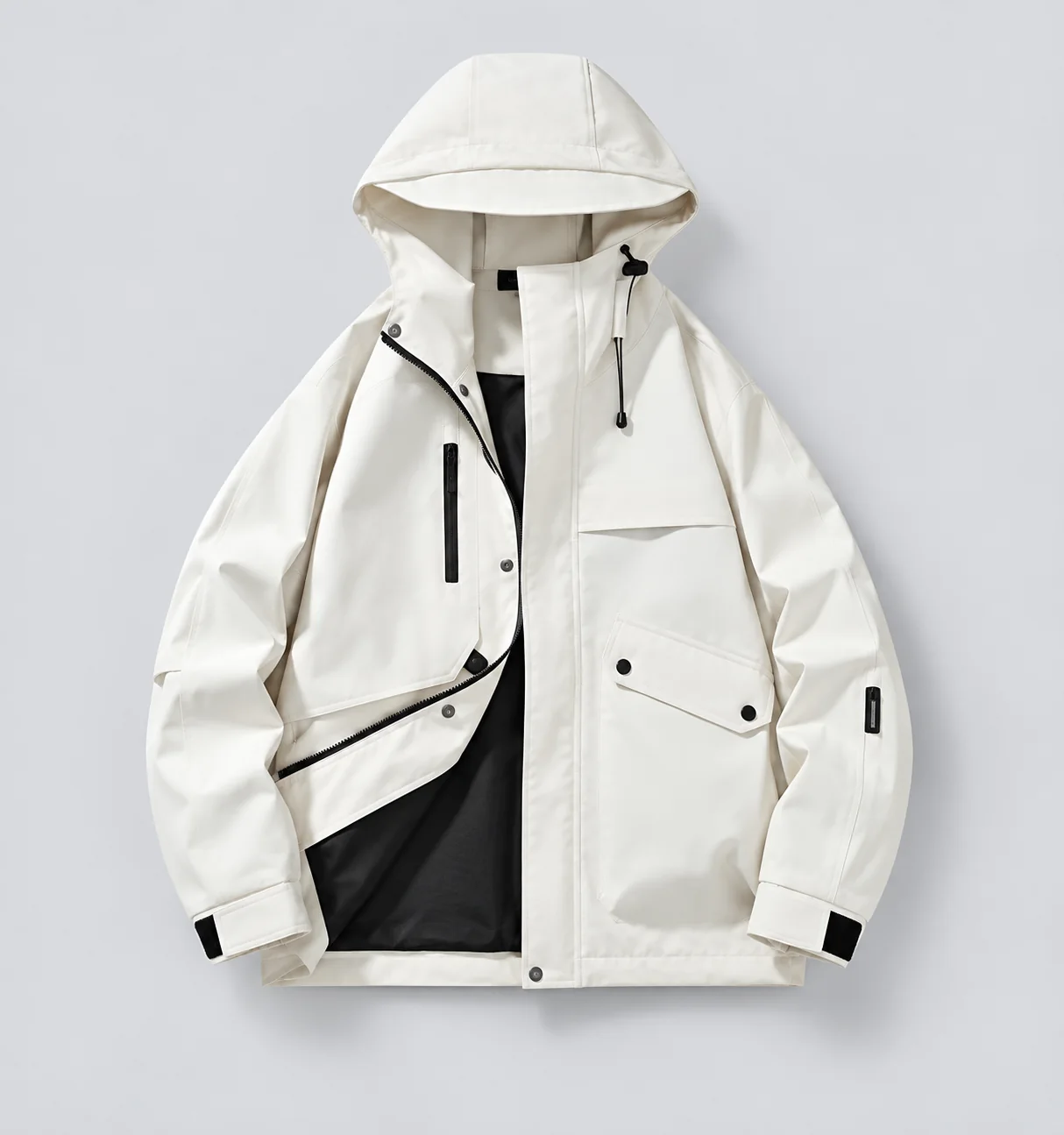
“3-in-1” and “3-layer” sound similar, but they describe two different product ideas. A 3-in-1 jacket is a modular garment system, usually an outer shell plus a removable insulating or fleece liner that can be worn together or separately. A 3-layer waterproof jacket describes a bonded fabric construction in which face fabric, waterproof-breathable layer or coating system, and inner backing are assembled into one material package.
For a brand buyer, confusing these terms can lead to a bad brief, mismatched quotations and unclear customer messaging. One choice is about how the wearer can layer the garment. The other is about how the shell fabric is constructed. A jacket can be a 3-in-1 system with a two-layer shell, or it can use a three-layer shell fabric; the terms are not interchangeable.
This guide explains how to choose between them for an outdoor, travel, workwear or private-label collection. It focuses on commercial and product-development decisions rather than treating either construction as automatically superior.
The short answer
Choose a 3-in-1 jacket when the collection needs flexible warmth across changing temperatures and the customer benefits from three wearing configurations: shell alone, liner alone and combined system. Choose a 3-layer shell when the collection needs a focused weather-protection outer layer and the buyer wants to optimise the shell fabric package, weight, durability, feel and construction for a defined use case.
Many brands need both. A 3-layer shell can be a technical core style for wet-weather activity, while a 3-in-1 product can serve travel, everyday outdoor use or corporate winter programs where versatility is central to the customer proposition.
1. Understand what each name actually describes
What is a 3-in-1 jacket?
The term normally refers to a connected outer shell and inner layer. The shell can provide wind and rain protection according to its material and construction. The removable liner supplies warmth or comfort, often using fleece or insulation. The connection may use a front zipper, neck attachments, sleeve tabs, snaps or a combination of these details.
The user normally gets three options:
- the outer shell alone for mild or wet conditions;
- the liner alone for dry, cool conditions; and
- both pieces together for colder or mixed weather.
That product logic is compelling when buyers want a jacket that covers several seasons without requiring three separate purchases. It also creates more development decisions: attachment points, liner fit, sleeve movement, neck comfort, compatible colours, labelling and the way both garments work as a combined unit.
What is a 3-layer waterproof jacket?
The term refers to the fabric package of the shell. In a typical three-layer concept, the outer face fabric, protective weather layer and inner backing are bonded together. The finished fabric is then cut and sewn into a jacket. The performance of the final garment still depends on seam treatment, closures, pattern, hood construction, care and the actual materials used.
A three-layer fabric direction can be useful when a buyer wants a more integrated shell with a defined hand feel and a reduced need for a separate hanging lining. It can also require careful discussion about noise, drape, abrasion expectations, packing, cost and the target activity. The number “three” tells the buyer about the material package, not the number of garments that can be worn separately.
2. Compare the product decisions side by side
| Decision area | 3-in-1 jacket system | 3-layer shell jacket |
|---|---|---|
| Core idea | One product with shell, liner and combined configurations | One outer shell using a three-layer bonded fabric package |
| Customer benefit | Temperature and styling flexibility | Focused weather-protection layer and technical shell identity |
| Main development complexity | Attachment system, fit of two garments, liner and shell compatibility | Fabric package, seam treatment, pattern, openings and hood design |
| Seasonal role | Broad shoulder-season to winter use, depending on liner | Wet-weather outer layer; insulation is usually planned separately |
| SKU implications | More components and potential colour/size combinations | Simpler garment system, but technical fabric choices can drive MOQ |
| Marketing message | “Wear it three ways” and adaptable layering | “Technical shell” with claim wording tied to verified material and garment evidence |
| Inspection focus | Attachment operation, liner mobility, combined fit and each piece separately | Seam workmanship, tape where used, closures, fabric and finished-shell checks |
The table is a starting point, not a substitute for a product brief. A light travel 3-in-1 and a winter workwear 3-in-1 can have very different liners and shell requirements. Likewise, three-layer shell products can range from clean everyday styles to more technical outdoor designs.
3. Start with the wearer and season, not the construction name
Before sending a quotation request, write a one-sentence job to be done. For example:
- “A travel-focused jacket for customers who move between rain, cool evenings and indoor transit.”
- “A corporate outdoor jacket that employees can wear through a variable winter workday.”
- “A hiking shell intended to protect the wearer from wet conditions while allowing separate midlayers.”
- “An outdoor retail shell that needs a clean technical profile and a year-round layering role.”
The first two examples may favour a modular 3-in-1 direction because convenience and warmth flexibility are part of the user promise. The latter two may favour a dedicated shell because the customer is expected to build warmth with separate layers. But these are hypotheses to test with target-price, fabric and fit decisions.
Questions that clarify the direction
Ask your product team and supplier:
- Does the wearer need meaningful warmth from the product, or only weather protection?
- Will the liner be sold as a valuable standalone piece, or is it only a hidden component?
- Is the jacket mainly for stop-start activity, commuting, travel, work or sustained outdoor movement?
- How much room is needed for separate layers under the shell?
- Which climates and selling seasons matter most?
- Does the retail channel value perceived versatility enough to support the added component cost?
- Will the customer understand and use the attachment system?
These questions produce a better brief than asking whether a 3-in-1 is “better” than a 3-layer shell. Each serves a different product story.
4. Develop a 3-in-1 system as two garments and one system
The most common weakness in a 3-in-1 project is treating the liner as an afterthought. The shell and liner must work separately and together. A liner that looks good alone can bunch at the shoulders when attached. A shell that fits well with a thin midlayer may become restrictive when the liner is zipped in. The wearer should be able to operate the connection points without creating discomfort or visible distortion.
Shell decisions
Specify the shell’s use case first. Is it a water-repellent travel layer, a waterproof workwear shell, or a more demanding outdoor construction? State the desired claim only after agreeing on evidence and test scope. Review the hood, front closure, pocket openings, cuff adjustment and hem adjustment as part of the shell function.
Liner decisions
Choose the liner according to warmth need, bulk, comfort, cleaning requirements and target price. Fleece can give a familiar, soft feel and can work as a standalone piece. Synthetic insulation can offer a different warmth-to-bulk direction. The correct option depends on the intended user and approved material data, not on a generic “winter jacket” label.
Interface decisions
Treat the joining system as a critical functional feature. Confirm:
- attachment points at the neck, sleeves and front;
- whether the liner cuffs stay in place when the wearer removes the shell;
- zipper length, puller size and compatibility;
- whether the liner exposes branding or care labels when worn alone;
- how the two pieces move at shoulder and elbow points;
- whether the colour and trim relationship works in all three configurations; and
- whether the combined product can be packed, labelled and inspected without confusion.
During sample review, photograph the shell alone, liner alone and combined jacket from the front, back and key inside attachment points. Ask a wearer to put the system on and remove it. A static mannequin does not reveal every connection issue.
5. Develop a three-layer shell around verified requirements
For a 3-layer shell, the fabric package must be matched to the intended activity and customer expectation. Ask the supplier for the material specification, available colours, composition, weight range, finish, backing description and proposed seam process. If a waterproof or breathability claim is intended, agree the wording and evidence before it reaches product photography, hangtags or an ecommerce page.
RASKOR’s VY9143 and VY9145 catalog styles are useful examples of a product direction built around 100% polyester three-layer bonded construction. They show hoods, adjustable cuffs and hem-adjustment details that can be discussed in an OEM project. The catalog does not provide a waterproof rating or breathability value for these styles, so those figures should be confirmed through the chosen fabric and test plan rather than copied into marketing content.
A three-layer shell still needs garment-level planning
The three-layer description does not answer every manufacturing question. A buyer must still define the following:
- whether the seams require full taping, critical taping or another agreed construction;
- the front closure and pocket-opening approach;
- hood volume, adjustment and visor shape;
- fit allowance for base and midlayers;
- reinforcement needs in high-wear areas;
- ventilation and comfort requirements;
- logo application method; and
- care requirements for the finish and materials.
This is where a supplier’s technical questions are valuable. A quote that identifies unknowns is easier to improve than a quote that hides them under a broad “waterproof jacket” description.
6. Consider cost, MOQ and range architecture early
The cost of a 3-in-1 product is not simply the cost of one jacket multiplied by two. It involves two garments, connection components, labels, packaging decisions and more sample-review work. On the other hand, a well-planned system can make a strong retail proposition because it covers several wearing conditions.
Three-layer shells can concentrate cost in the fabric package, seam process and technical details. The commercial decision often lies in how the material and construction support the desired position without adding features the target user will not value.
For either product direction, ask the supplier to separate:
- bulk price at specified quantity;
- sample and development charges;
- fabric or custom-colour minimums;
- branded trim, print and label cost;
- testing and inspection scope;
- packaging;
- quoted Incoterm; and
- changes that would affect unit price or lead time.
If you are building an outerwear range, do not force every product to be all-season. A clear line can include a modular 3-in-1 option for broad climate flexibility and a focused shell for more technical rain protection. The range is easier to explain when each style has a distinct job.
7. Plan testing and inspection around the product type
For 3-in-1 systems, inspection should include the shell, liner and combined product. Check measurements in each intended configuration, attachment strength and placement, zipper operation, collar comfort, lining visibility, colour matching and branding. Verify that packaging identifies the two pieces correctly and that size labels align.
For a three-layer shell, inspect the approved fabric and the finished garment. Review seam workmanship, seam tape where applicable, closures, pockets, hood adjustment, logo application and measurement points. If the brand will make performance claims, agree the relevant testing and evidence before production—not after stock reaches a warehouse.
In either case, the approved pre-production sample should be the reference for a shipment inspection. A shipment inspection team needs the measurement chart, approved colour, construction notes, packaging instructions and tolerance policy. “Check quality carefully” is not an inspection standard.
Claims need a proof pathway
Terms such as waterproof, breathable, wind-resistant, recycled, PFAS-free or durable water repellent can have commercial and regulatory implications. Do not use a generic catalogue phrase as proof. Ask what documentary evidence is available for the exact material, finish or finished garment being ordered, and make sure the retail language does not go beyond it.
8. A practical selection framework for buyers
Use this short decision tree:
Choose a 3-in-1 direction if:
- the main benefit is adaptable warmth across changing conditions;
- the liner is expected to be useful on its own;
- the customer understands a modular system;
- the collection needs a visible “three ways to wear” story; and
- your sampling calendar allows time to refine the shell-liner interface.
Choose a 3-layer shell direction if:
- the main benefit is a dedicated technical outer layer;
- the wearer will select separate base and midlayers;
- material hand, shell durability and wet-weather construction are central to the range;
- you want a cleaner single-garment system; and
- performance language can be supported by approved specifications and tests.
Consider carrying both if:
- you serve different climates or customer segments;
- one style cannot meet both a broad winter-use brief and a focused technical-shell brief; or
- your price architecture needs a flexible entry-to-mid level option plus a more technical outer shell.
FAQ
Do 3-in-1 jackets and 3-layer waterproof jackets mean the same thing?
No. A 3-in-1 jacket describes a modular shell-and-liner garment system. A 3-layer jacket describes the construction of a shell fabric package. One describes how garments work together; the other describes how material layers are bonded.
Is a 3-in-1 jacket automatically warmer than a 3-layer shell?
Not automatically. A 3-in-1 can include a warming liner, while a shell is usually designed to be layered over separate insulation. Actual warmth depends on the liner or midlayers, fit, construction and use conditions.
Can a 3-in-1 jacket use a three-layer shell fabric?
Yes. The terms answer different questions. A project can specify a modular system and separately specify the shell-fabric construction. The supplier should review the resulting bulk, cost and wearing comfort.
Which option is better for private-label corporate winter jackets?
It depends on climate, wearer activity, branding needs and budget. A 3-in-1 may suit a program that needs flexible warmth and a standalone liner. A shell plus separately specified layers may suit a more technical or uniform-focused brief. Send the use case before choosing.
What should I send a 3-in-1 jacket manufacturer for a quotation?
Provide intended use, target climate, shell and liner direction, reference images or tech pack, quantity by colour and size, logo requirements, target date, packaging and required claims or documents. State whether the liner must be wearable separately.
Conclusion
The useful comparison is not “which product has more layers?” It is “which construction delivers the customer promise with a clear manufacturing path?” A 3-in-1 system is about versatile wear across conditions. A three-layer shell is about an integrated outer-fabric construction. Once the brand defines the wearer, climate, range role and target position, a manufacturer can help turn the choice into a precise sample and quotation plan.