An outdoor brand may start with a simple request: “Can you make a PFAS-free waterproof jacket?” For a buying team, that is the beginning of the specification, not the finished specification. A jacket combines face fabric, durable water-repellent finish (DWR), membrane or coating, seam tape, zippers, prints, labels and sometimes insulation. A statement about one layer does not automatically describe the whole garment. Meanwhile, “waterproof” is a performance claim that needs its own evidence.
The most useful supplier brief separates chemical scope from weather-protection performance. State which materials and components must meet your PFAS policy, how the claim will be substantiated, and what the finished jacket needs to do in use. Then agree on samples, test methods and records before bulk materials are booked. This guide gives outdoor brands, private-label teams and importers a practical sequence for that conversation.
The short answer for sourcing teams
To source a PFAS-free waterproof jacket, first define whether the requirement is “no intentionally added PFAS” or a market-specific analytical limit. Map every relevant component, obtain supplier declarations and appropriate test evidence, and agree on the exact finished-product claim. In parallel, specify rain exposure, fabric water-penetration resistance, seam construction, fit, breathability and care. Approve the proposed material package and a representative pre-production sample before releasing bulk production.
Do not treat “C0 DWR,” “PFC-free,” “PFAS-free membrane” and “PFAS-free garment” as interchangeable certificates. Each phrase may describe a different part of the product or a different evidence standard. Ask the mill and manufacturer exactly what the declaration covers and what it excludes.
1. Define the claim before requesting a quotation
PFAS is a family of many substances. In outerwear, discussions often focus on fluorinated water-repellent finishes, but an individual construction can involve several inputs. A supplier may offer a fluorine-free face-fabric finish while another component has not yet been reviewed. A “PFAS-free” claim should therefore have a written scope instead of being inferred from a marketing label.
For a first brief, answer these questions:
- Is the policy “no intentionally added PFAS,” or does a retailer or jurisdiction require particular substances and limits to be tested?
- Does the policy cover only the shell fabric, or the complete finished jacket and its trims?
- Which markets will receive the product, and who will review the final wording on the product page and hangtag?
- Which supplier declarations, bills of materials and laboratory reports are acceptable to the buyer?
- Will a change of mill, finish, colour, coating or trim require renewed approval?
Write the requested wording in the purchase brief. “The face fabric uses a finish declared by the mill to contain no intentionally added PFAS” is narrower than “This jacket is PFAS-free.” The right public claim depends on evidence for the specific style, production lot and market. A supplier's general sustainability page is not a substitute for product-specific documentation.
Understand the regulatory context without assuming one global rule
Rules differ by region, product type and date. The European Chemicals Agency (ECHA) identifies textiles, leather and apparel as relevant PFAS-use sectors and describes both existing restrictions on some subgroups and an ongoing broader restriction process. The EU has also adopted a specific restriction on PFHxA and related substances that explicitly discusses clothing such as rain jackets. These sources do not mean that every PFAS use in every outdoor jacket is already prohibited under one universal rule. Check the applicable law and retailer requirements for the destination market and shipment date. ECHA's PFAS overview and the EU PFHxA regulation are useful starting points for a compliance review.
For export orders, the brand or importer should decide which claim it intends to make and which evidence it will accept. The manufacturing brief can then specify those requirements. If the project includes certified protective clothing, involve the buyer's compliance specialist early because a technical rain shell and regulated PPE are different product categories.
2. Review the complete jacket material map
A chemical-policy discussion works best with a component list. The face fabric is the obvious starting point, but a finished jacket can include additional materials that are easy to miss during sampling.
| Component | Buyer question | Evidence to request |
|---|---|---|
| Face fabric and DWR | Which finish is used on the approved fabric code and colour? | Mill declaration, finish specification and sample identity |
| Membrane or coating | What polymer or coating system is proposed? | Material specification and supplier declaration |
| Backer, lining and insulation | Are these included in the buyer's claim scope? | Component list and declarations where relevant |
| Seam tape and adhesive | Is the tape compatible with the selected laminate and policy? | Tape specification, supplier statement and sample review |
| Zippers, pulls and trims | Does the policy include coatings or finishes on trims? | Trim list and targeted declarations |
| Logos, labels and prints | Could a transfer film, ink or badge affect the scope? | Artwork method, material identification and approval record |
Do not assume a component contains PFAS merely because it is synthetic, nor assume it is free of PFAS because it is labelled “eco.” The point of the map is traceability. Ask each upstream supplier to identify the exact material supplied for the style, then match those references to the garment bill of materials. If a component changes after sample approval, update the map before the substitution enters production.
What “C0 DWR” does and does not answer
In sourcing conversations, “C0” commonly signals a non-fluorinated water-repellent finish. It is useful information about that finish, but it does not establish a complete-jacket chemical claim, a waterproof rating or wash durability. Request the finish chemistry description available from the mill, the fabric code, the test report and the care conditions. Ask whether the proposed bulk fabric will use the same finish and process as the tested sample.
The face finish helps water bead and run off. A membrane or coating, fabric structure and garment construction address other parts of rain protection. If the DWR wets out after wear or laundering, the outer fabric can feel damp even when a membrane still resists water penetration. Set a realistic maintenance and retesting plan instead of asking one initial spray result to represent the jacket's whole life.
3. Specify waterproof performance separately
A buyer can remove intentionally added PFAS from a chosen finish and still need to decide how much weather protection the jacket should provide. Start with the wearer and use case: a short city commute, travel, multi-hour hiking and exposed field work place different demands on the shell. Define expected exposure, activity, layering and target price before choosing a material stack.
At minimum, ask the supplier to identify:
- face-fabric fibre, weight and hand feel;
- two-layer, 2.5-layer or three-layer construction, where relevant;
- membrane or coating type and intended waterproof claim;
- fully taped, critically taped or untaped seam plan;
- front-closure, hood, cuff, hem and pocket-opening protection;
- ventilation or moisture-management priorities; and
- intended care instructions and expected performance after care.
Use test methods that answer the correct question. ISO 4920 measures resistance to surface wetting; ISO explicitly states that this spray test does not predict rain penetration. ISO 811 measures fabric resistance to water penetration by hydrostatic pressure. Neither fabric result alone proves that a finished jacket's seams, openings and construction will keep a wearer dry. Where the project requires a garment-level claim, agree on an appropriate finished-product inspection or test plan as well.
Do not publish a “10K,” “20K” or breathability figure based on a reference photo or a supplier's generic catalogue. Record the test method, specimen identity, laboratory, date, conditioning and whether the report refers to the approved bulk material. If two suppliers use different methods, compare the methods before comparing the numbers.
4. Build an evidence pack that follows the production lot
A practical evidence pack is not just a folder of unrelated certificates. It connects the buyer's claim to the exact style being produced. Start with the approved bill of materials, including supplier names and material codes. Add dated declarations for relevant components and test reports for the agreed performance and chemical scope. Link each document to the fabric colour, finish, lot or garment sample where possible.
One useful approval record has four columns: requirement, evidence, responsible party and status. A “pending” status is better than silently treating a missing report as passed. Separate material approval from garment approval. The fabric may satisfy an agreed chemical screen while the seam-taped garment still needs workmanship review; the reverse is also possible.
When laboratory testing is part of the contract, agree the analytes or screening approach, detection limits, sampling unit and laboratory before sending samples. A “non-detect” result depends on the method and reporting limit. A certificate for a different fabric, old finish or earlier season does not automatically cover the current order. If the claim is broad, ask a qualified compliance adviser or laboratory whether the proposed test programme supports that wording in the destination market.
Avoid invented factory evidence. At quotation stage, no supplier should promise that an unselected fabric or future bulk lot has already passed a test. A trustworthy answer states which evidence exists now, which evidence is available from the mill and which checks must be completed after material selection or bulk production.
5. Test the sample as a product, not as a swatch
Ask for a representative jacket sample in the proposed fabric and trim package. Review the face, inside, hood, shoulder, underarm, zipper and pocket construction. Check seam tape at curves and junctions for lifting, wrinkles or gaps. Inspect logo application, especially when heat transfer or stitching meets a laminate. Confirm that a logo or badge does not create an unplanned water-entry point.
For an OEM project, the sample review can follow this sequence:
- Confirm the brief. Check end use, fit, size market, target price and permitted claims.
- Identify materials. Match the sample fabric, finish, membrane, tape and trims to the bill of materials.
- Review construction. Inspect seam sealing, hood coverage, closures, pockets and adjustment points.
- Test the right properties. Use the agreed methods for chemical scope, surface wetting, water penetration and any other required claim.
- Record revisions. Mark each issue as approved, pending supplier answer, pending test or requiring a new sample.
- Release a reference. Keep a dated pre-production sample and approved documents for bulk inspection.
If a fabric substitution improves the chemical profile but changes hand feel or seam-tape adhesion, re-evaluate the garment. “Equivalent” should be demonstrated against the agreed use case, not assumed from similar fibre content. The same applies when shifting a colour to a new dye lot or using a new water-repellent finish.
6. Make the supplier quotation comparable
Request an itemised quote that identifies the proposed fabric package, available finish options, seam-taping scope, testing responsibility and one-time sample costs. Ask whether minimum order quantity applies per style, colour, fabric or trim. A low unit price with unclear laboratory, sample and inspection costs is difficult to compare with a quote that includes them.
The most useful supplier response also identifies open decisions. It might say that an available shell style can serve as a fit and construction reference, while a different fabric and documentary package would be needed for the buyer's requested claim. This is a valid development route. It is more credible than relabelling an existing jacket without changing or checking the materials.
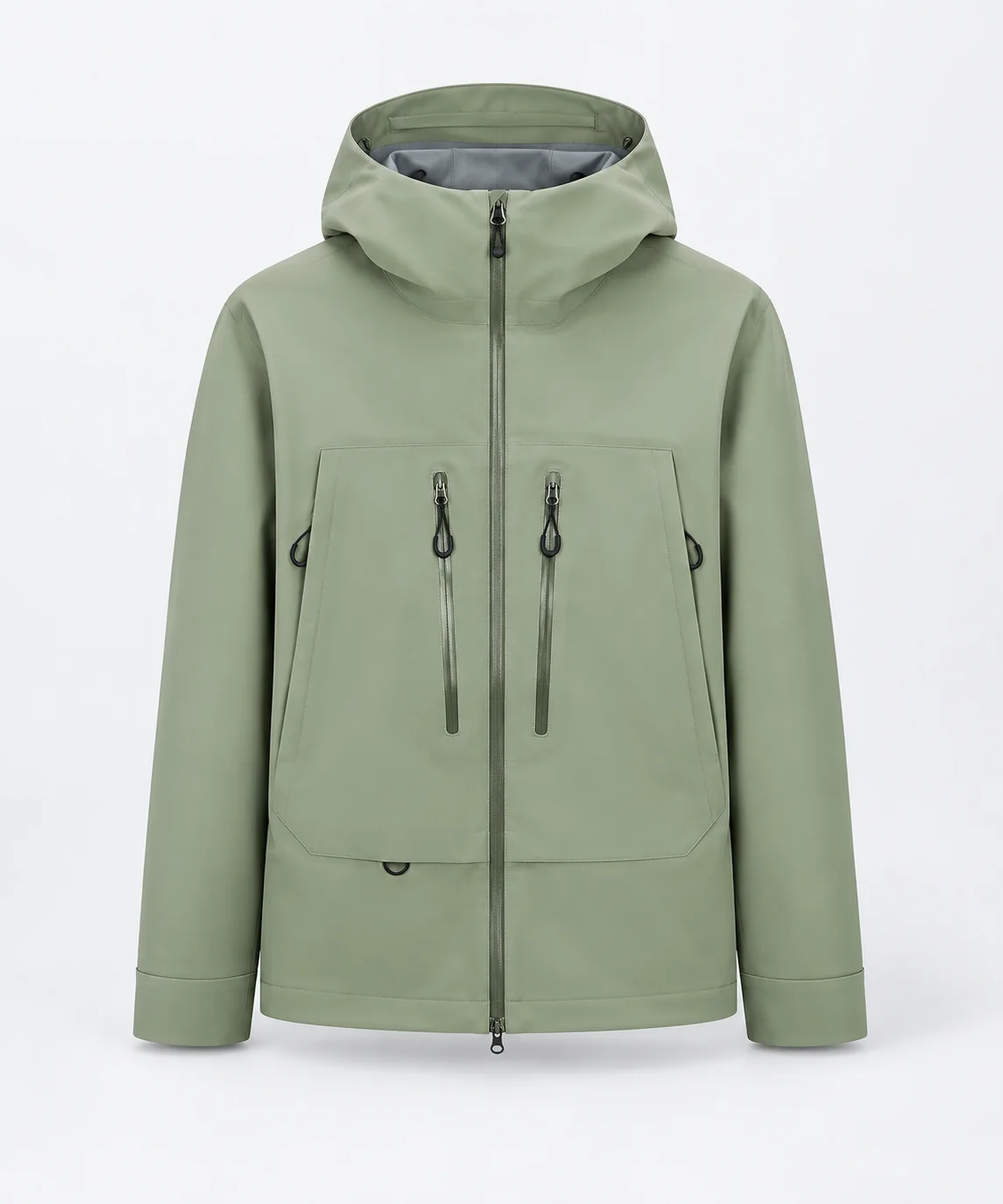
RASKOR's technical shell jacket range includes styles such as VY9143, which can act as visual and construction starting points for an OEM discussion. The public catalogue does not establish a PFAS-free status, certified chemical result or waterproof rating for those styles. Any such claim for a new programme would need to be agreed, sourced and supported by the approved material and test evidence.
A short RFQ template buyers can send
The following brief helps an outdoor brand obtain a more precise first answer:
| Field | What to provide |
|---|---|
| Market and claim | Sales countries, retailer policy and exact PFAS-related wording under review |
| Product role | Commuter, travel, hiking, teamwear or field-work shell |
| Weather requirement | Rain-exposure scenario and proposed test methods, not just a marketing number |
| Material direction | Preferred hand feel, weight, fabric construction, colour and finish |
| Chemical scope | Included components, declaration format and laboratory evidence required |
| Style direction | Reference jacket, hood, pocket, closure, fit and branding details |
| Commercial terms | Quantity by style/colour/size, target price, delivery window and destination |
| Approval path | Sample stages, report owners, substitution rules and pre-shipment checks |
If information is missing, say so in the RFQ. An honest “finish to be selected after supplier review” lets the factory propose options. It is better than stating a claim that the project team has not defined.
Frequently asked questions
Does a fluorine-free DWR make the whole jacket PFAS-free?
No conclusion about the whole jacket follows from the face finish alone. Determine the buyer's claim scope and review the other relevant components, including membrane or coating, seam tape, trims, branding and any lining. Request evidence tied to the selected style and lot before making a finished-product claim.
Can a PFAS-free jacket still be waterproof?
The chemical scope and waterproof performance are separate questions. Waterproof performance depends on the selected fabric package and garment construction. Agree on suitable test methods and review the complete sample. Do not infer a finished-garment result from a DWR label or a fabric-only report.
Is a spray-test result proof of a waterproof jacket?
No. ISO 4920 is a surface-wetting test and does not measure water penetration through fabric. A buyer may also need an ISO 811 fabric test and a separate garment-construction review, depending on the intended claim and use case.
What is the difference between “PFC-free” and “PFAS-free”?
Both terms appear in marketing, but their scope can be interpreted differently. Do not rely on the label alone. Ask the supplier which substance family, component and production stage the statement covers, then choose wording that matches the documents and market requirements.
Should a buyer require a laboratory test on every bulk order?
The answer depends on the claim, risk, retailer rules and contract. Agree the sampling plan before production. At minimum, prevent unapproved material substitutions and keep lot traceability. If the compliance claim is material to the sale, specify who orders the test and how an out-of-scope result will be handled.
Conclusion
A strong PFAS-related jacket brief combines a precise claim, a complete material map and a separate performance specification. It gives the supplier a way to propose realistic fabrics and construction, gives the buyer a way to compare quotations and creates a clear path from sample to bulk approval. Treat each style and production lot as an evidence-based project. The result is a better buying decision and a product description that can be defended.